- Above is European and US GDP from Eurostat, including the latest data for Europe (Q1). The European economy continues to shrink. Some enterprising university over there needs to make Paul Krugman an offer he can't refuse so that he can nag their elites endlessly to reinflate the economy.
- The weather is really losing it in the US midwest.
- A bibliography of papers on artificial intelligence risk.
Thursday, May 16, 2013
Thursday Links
Labels:
links
Wednesday, May 15, 2013
Tuesday, May 14, 2013
Tuesday Links
- The above is the Yen/$ exchange rate since 1970. The uptick on the far right is the initial effects of Abenomics (essentially making somewhat credible threats to increase inflation by increasing the money supply). Some more interesting charts here from Edward Hugh, along with a rather sceptical take. I'm inclined to think it's a bit too soon to draw any firm conclusions.
- Someone may be studying how to perform destructive cyber-attacks on energy infrastructure.
- The children of the upper class and upper middle class are increasingly stressed out by the process of being prepared for today's hyper-competitive globalized society.
- Related: student debt and the crushing of the American dream.
- There are severe financial consequences to firmly predicting global doom and being wrong.
- Kevin Drum has a very good piece about the economic consequences of approach to singularity. His views and mine are rather similar in the short to medium term (and he even uses one of my graphs). In the long term, I'm rather less optimistic about the "robotic paradise of leisure and contemplation" than he is. That assumes that a highly intelligent economic system with no need at all for humans will continue to prioritize their welfare for many generations. Building the system to guarantee that strikes me as very hard to do.
- This Bertrand Russell essay on the value of idleness was written in 1932, but still seems trenchant today (I'm personally struggling with how to think about these issues in the context of the approaching singularity). H/T Ran Prieur.
Labels:
links
Monday, May 13, 2013
April Oil Supply Little Changed
The April numbers are out from the IEA and OPEC, and the overall pattern of flat supply since 2012 is continuing (graph above, not zero-scaled).
I refer you to last month's update for a much more detailed explanation of the context. April seems to have changed the picture so little that it doesn't make sense to repeat everything in there.
Labels:
global production,
oil production
Sunday, May 12, 2013
Weekend Links
- I can't help feeling a grudging sense of admiration at the audacity of this cyber-heist.
- The next pandemic.
- 400ppm.
- Sustainable biofuel production at work.
Labels:
links
Friday, May 10, 2013
Poem for Friday
I don't feel like blogging this morning. Accordingly, this post is being outsourced to poet and farmer Wendell Berry:
Even while I dreamed I prayed that what I saw was only fear
and no foretelling,
for I saw the last known landscape destroyed for the sake
of the objective, the soil bludgeoned, the rock blasted.
Those who had wanted to go home would never get there now.
I visited the offices where for the sake of the objective
the planners planned
at blank desks set in rows. I visited the loud factories
where the machines were made that would drive ever forward
toward the objective. I saw the forest reduced to stumps and gullies; I saw
the poisoned river, the mountain cast into the valley;
I came to the city that nobody recognized because it looked
like every other city.
I saw the passages worn by the unnumbered
footfalls of those whose eyes were fixed upon the objective.
Their passing had obliterated the graves and the monuments
of those who had died in pursuit of the objective
and who had long ago forever been forgotten, according
to the inevitable rule that those who have forgotten forget
that they have forgotten. Men, women, and children now
pursued the objective
as if nobody ever had pursued it before.
The races and the sexes now intermingled perfectly in
pursuit of the objective.
the once-enslaved, the once-oppressed were now free
to sell themselves to the highest bidder
and to enter the best paying prisons
in pursuit of the objective, which was the destruction
of all enemies,
which was the destruction of all obstacles, which was the destruction
of all objects,
which was to clear the way to victory, which was to clear the way
to promotion, to salvation, to progress,
to the completed sale, to the signature
on the contract, which was to clear the way
to self-realization, to self-creation, from which nobody who
ever wanted to go home
would ever get there now, for every remembered place
had been displaced; the signposts had been bent to the
ground and covered over.
Every place had been displaced, every love
unloved, every vow unsworn, every word unmeant
to make way for the passage of the crowd
of the individuated, the autonomous, the self-actuated, the homeless
with their many eyes opened toward the objective
which they did not yet perceive in the far distance,
having never known where they were going,
having never known where they came from.
Labels:
poetry,
wendell berry
Thursday, May 9, 2013
Thursday Links
- Above - continued decline of retail trade in Europe.
- Vaunted venture-capital fund Kleiner Perkins has lost money on its green-tech investments. I think probably this bet will be a winner eventually, but, as a sage investor friend once told me "Being right too early is just as bad as being wrong". Making this kind of portfolio pay is going to take stronger government action to even up the playing field between renewables and fossil fuels (which don't currently pay their externalities of wrecking the global climate).
- One for the Annals of Unnecessary Innovations.
- How the town of Dryden, NY banned fracking and has so far made the ban stick in court. I live in Dryden, and Marie McRae, mentioned in the story, lives just up the road from me. I think the story underplays a bit the influence of Ithaca/Cornell in Dryden; the western part is very heavily influenced by commuters and I think it makes the town quite a bit more affluent and progressive than a typical rural upstate town.
- Another computer scientist concerned about what automation is doing to the economy and the middle class.
- It'a a good time of year to do an energy audit of your house, if you didn't already do so.
- The paradigm seems to be shifting away from austerity. If more expansionary thinking were to take hold, particularly in Europe, it considerably raises the odds of an oil price shock in the next few years.
- Return on equity for oil and gas producers in the US (2011/2012). Pure oil producers did ok (not fantastic) with about 12% ROE, but pure natural gas producers were losing money hand-over-fist. So US natural gas prices were unsustainably low, but US oil prices (ie mainly WTI probably) were roughly where they needed to be.
Labels:
links
Wednesday, May 8, 2013
Tuesday, May 7, 2013
Tuesday Links
- Even Hollywood script writers are now getting help from machines, it seems.
- Weather whiplash impacts Georgia - extreme drought to floods in four months.
- The scientist who saved more lives than any other in the 20th century: wow, there's an epitaph. Mildly O/T.
- US government accuses China of cyber-attacks on US defense infrastructure.
Labels:
links
Monday, May 6, 2013
Sunday, May 5, 2013
April PDSI Map for California and Nevada
From the West Wide Drought Tracker. Lots of -5 and -6. Looks like a very bad fire season indeed.
For newer readers who don't understand the PDSI scale, try this post.
Labels:
california,
drought,
PDSI
Weekend Links
- The above shows estimates of the maximum volume of ice in the Arctic each winter (red), and the amount of it melting each summer (blue). When the two curves meet, then the Arctic will be ice free in September. Hard to see how it's more than a decade off. Could even be just a couple of years off if the noise goes the wrong way. At any rate, it's a done deal I think. We are irrevocably committed to having melted the North Pole, and now we get to find out the consequences.
- Australia slowing down due to (relative) slowdown in big Asian economies.
- New nationalist party making gains in the UK.
- Putative new motto for Silicon Valley: First Security, then innovate. Good luck with that.
- Interesting essay on why we tell children so many stories about animals.
- Early wildfires bode ill for California. Below is a NOAA map for the soil moisture anomaly across the US as of yesterday. A lot of California has 4-7" less water in the soil profile than a normal year (1971-2000 is the base period). That's a lot. Given that the rainy season there is over by now, there's no way to make it up. So likely this is going to be a rough fire year. And a lot of the western US looks only slightly better off.
Labels:
links
Thursday, May 2, 2013
Thursday Links
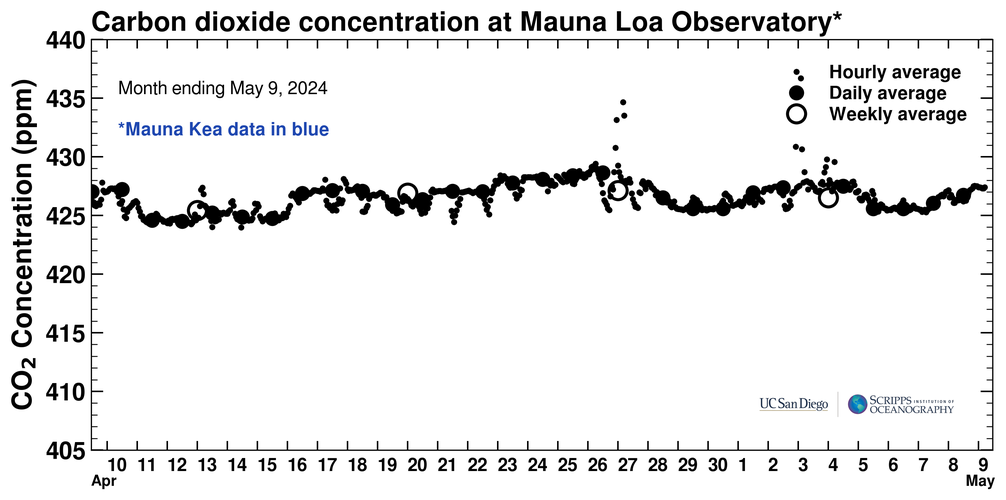
- We're about to cross 400ppm of carbon in the famous Mauna Loa measurement series. 399.5 ppm today. If you look at the monthly graph, there have been some hourly averages that have tipped over the line.
- Storage options for renewable power (nice summary by Robert Rapier).
- Bakken recoverable oil estimates are growing again. At a 5% depletion rate, 7.4 gb gives about 1mb/d of production.
- Completely off-topic, but it really sounds like scientists are starting to get somewhere with cancer. Pretty exciting stuff.
- Speaking of amazing but off-topic medical progress: possible new understanding of aging being regulated by the hypothalamus. I've had a strong suspicion that aging must be centrally regulated just from reflecting that dogs and cats get a lot of the same chronic diseases as humans, just on a much accelerated timeline, suggesting they are somehow part of the normal aging process.
- Hopefully, scientists will get on this stuff promptly before I get too much older (although, I have to admit very uncharitably that I'm hoping not before Ray Kurzweil gets too old).
Labels:
links
Wednesday, May 1, 2013
Tuesday, April 30, 2013
Tuesday Links
- Scanning the entire internet. This is what you need to do in preparation to release a global flash worm. Interesting now that a motivated individual can do it with personal resources.
- Difficulties in heating green homes - standard heating equipment is too big for the job and then tends to heat the house unevenly. Amazing quote: "But if the doors are closed, the bedrooms will be 5 degrees colder than the hallway — even 10 degrees is possible. That’s OK for some people, but other people don’t like that. What temperature ranges are acceptable? The mass market is saying 3 degrees of variation from room to room. But in homes without any heat distribution to the bedrooms, when we measure the temperatures we get more than that." Boy are we pampered. I hate to go into "when I was a kid" mode, but I can't help myself. My bedroom as a child would often get down into the high thirties and low forties on the coldest days of winter (as a scientifically minded child I made a point of obtaining a thermometer and measuring it). And people now won't tolerate more than 3oF drop in the bedroom?
- What happens to workers who drop out of the labor force.
- If this was a pill, you'd do anything to get it.
Labels:
links
Monday, April 29, 2013
Friday, April 26, 2013
Wednesday, April 24, 2013
Thursday Links
- The above is an amazing National Geographic documentary, Chasing Ice, about photographer James Balog's quest to take multi-year time lapse photographs of receding glaciers. It will take 1hr 12min of your life, but will likely profoundly affect you, at least it did me. Some breathtakingly beautiful images, and an amazing story. And of course, the always sobering facts of what climate change is doing to ice everywhere. It's really well done.
- Fairly serious sectarian conflict in Iraq. If Iraq were to go the way of Syria, it would likely cause a noticeable oil shock to the global economy.
- Sounds like BP, during the Gulf disaster, knowingly exposed its cleanup workers to highly toxic dispersants, lied to them about the toxicity, and fired them if they complained. While human affairs are always highly vulnerable to corruption, it does seem like oil companies are particularly prone to it. It would be interesting to know more systematically what factors predispose an industry/company to corruption.
- Fisker is pretty much dead. Sometimes start-ups work out, sometimes they don't. C'est la vie. "If you can meet with triumph and disaster, and treat those two imposters just the same".
- Congress is actually holding hearings on the use of drones.
- New era of American innovation never gonna happen. (Onion humor).
Labels:
links
Latest Saudi Arabian Oil Supply
I'm resolved to follow Saudi Arabia a bit more closely after the big cut-back this winter. The above is the latest data: March shows a very slight increase in production (probably less than the uncertainties in the data, so we could call it basically flat over February). There was also one extra oil rig in country. No sign of a return to the mid 2012 production level at present.
Labels:
oil supply,
saudi arabia
Tuesday, April 23, 2013
Tuesday Links
- Tim Duy discussing the trade-offs between financial instability, low inflation, and full employment (essentially the idea that we can now only achieve full employment during an asset price bubble). I could be wrong, but my gut feel is that widening income-inequality has a good deal to do with this.
- Steve Randy Waldmann makes a related argument that technology/globalization has essentially turned societies like the US more like societies such as Nigeria - a generalized resource curse.
- Sudden stratospheric warmings. I didn't know the first thing about this, but it's fascinating, and seemingly very relevant to the weather this spring.
- Wunderground has seven Earth Day essays on Climate Change. Worth looking over.
- The Chinese are starting to get into SUVs according to the NYT. This was inevitable, I imagine:
S.U.V. sales jumped 49 percent in March from a year ago as new models poured into the market. Overall auto sales in China climbed 13 percent in March and are on track for almost 21 million vehicles sold this year. By comparison, the latest forecasts in the United States this year are for a little more than 15 million vehicles. Both totals include sales of pickup trucks and other light commercial vehicles.
- However, it's getting very hard to breath in Beijing. Sounds like China is close to reaching the kind of inflection point that came in the west with the Great Smog in London in 1952, which killed thousands of people and led to the 1956 Clean Air Act. If China adopts similar measures, this may worsen global warming in the short term as China is currently a large source of reflective sulphate aerosols that offset warming. Here's a picture of global spring-time anthropogenic aerosol depth from Fig 2 of Bellouin et al.
Clearly China is a massive contributor. Note that the distribution is different in different seasons, however - check the link for full details.
Labels:
links
Monday, April 22, 2013
Sunday, April 21, 2013
Weekend Links
- Are the good jobs gone?
- First priorities in building a green house.
- Iraq has held local elections, largely without problem. Analysts expect Maliki's State of Law coalition to do well, in part because the rise of Sunni rebels in Syria has made Iraqi Shiites rally around Maliki.
Labels:
links
Friday, April 19, 2013
Initial Conference Impressions
A few quick hits from the conference.
- I went to the opening plenary last night. I estimate there were about 250 people in the room. I thought this was seriously impressive for a local conference organized in two counties (Tompkins and Cortland) with about 150000 population between them. The conference is perhaps drawing from the larger region to some degree, but still, this is not a state-level conference in Albany or a national conference in Manhattan.
- My impression is the high level of interest is driven by two things: a) we have had some very extreme and variable weather here in recent years and it's really got people's attention, and b) the big fight about fracking has led quite a few people to a larger interest in energy/climate issues (if you start insisting that you don't want your region to be a fossil-fuel supplier, your conscience is apt to start nagging you that maybe you shouldn't be using too much fossil fuel either).
- The keynote speaker was Mark Hertsgaard, author of Hot: Living through the next Fifty Years on Earth. I liked his speech, it was inspiring.
- I couldn't help noticing that the parking lot outside the conference venue had a mix of vehicles that looked very typical of the region. Wall-to-wall Priuses and bicycles it was definitely not. I have a half a mind to do an actual sample tomorrow to get a sense of where we are at; have people who care enough about climate to attend a conference cared enough to make any detectable changes in their own lifestyle?
- The definitive word on climate change and New York State is NYSERDA's Climaid (600 pages but you can get it one chapter at a time).
- This morning I was in Cortland all morning for the section on adapting agriculture to climate change. The audience was smaller (it being a weekday), but the speakers were excellent - in the main session we heard from scientists and then at lunch we heard from actual growers. The basic message was the same from everyone:
- New York State has warmed noticeably, particularly in the winter. The growing season is longer. One big dairy operator mentioned that in 1973 he was planting 80 day corn on his hills and 90 day on his river bottom land, whereas today he is planting 95 day corn on the hills and 110 day corn on the bottomland.
- The weather is also noticeably more extreme. There are more droughts, more floods, more risk of frosts during the longer growing season, more occasions when they can't get machinery into the fields because the weather is too wet, and more big snowfalls. This showed up both in the scientist's statistics and also the grower's anecdotes. The scientists all pinned this on more moisture in the warmer atmosphere and changes in the circulation due to a warmer Arctic.
- Here are corn yields in New York State since 1945. There is the same linear pattern that yields often show nationally and globally. Although the climate is certainly affecting agriculture here in both positive and negative ways, apparently it all nets out to maintain roughly the existing trend:
- I got to ask a lot of questions. The most intriguing answers came in response to me observing that climate scientists seem to have been repeatedly blind-sided in the last decade, and did the scientist speakers have confidence in mainstream climate science projections or did they think there was a material risk of non-linear poorly understood processes causing significantly more radical change. None of them sounded reassuring. Dave Eichorn said that he agreed the situation was poorly understood and he wasn't confident that the changed weather patterns we are currently observing will still be the same in 20 years, or something else altogether might be occurring. Larry Klotz said that scientists are inherently conservative because they don't want to publish something that won't hold up in twenty years, so they shy away from making strong claims without being very confident of their ground, which contributes to the impression that they underplay the issues. He personally is speaking out more in part because he has a new grandchild. David Wolfe said that he, like a lot of his colleagues, tends to stick to mainstream projections to avoid losing credibility and/or sowing panic with less likely but possible scenarios. However, privately, climate scientists discuss amongst themselves the possibility of much more extreme scenarios and they cannot be ruled out.
Labels:
agriculture,
climate change,
corn,
crop yields,
new york,
united states
Thursday, April 18, 2013
Blog Housekeeping Note
I'll be spending some/much of the next few days at the Climate Smart/Climate Ready conference, which has a focus on regional response and adaptation here in upstate New York. Normal blogging will be interrupted, but there may be some conference blogging to the extent I think it has interest to my readers (who are globally distributed). The line-up of speakers is pretty impressive, so I'm hoping to learn quite a bit.
Labels:
administrivia
European Construction Stats
The latest came out a couple of days back. Clearly, life continues to be a vale of tears for European builders. Now going on seven years of unrelenting gloom, and no hope in sight.
Labels:
construction,
europe
Wednesday, April 17, 2013
Tuesday, April 16, 2013
Monday, April 15, 2013
Sunday, April 14, 2013
Weekend Links
- The above is the number of minutes to midnight on the Doomsday Clock at various times since it was inaugurated in 1947. The artist who designed the first version of it recently passed away.
- More on the prospects for a rapid melt of Arctic sea ice this summer.
- Wordpress blogs under attack (for possible use in a DDOS - distributed-denial-of-service - attack down the road).
- The argument for a pre-emptive strike in North Korea.
- Jeremy Grantham interview worth reading.
- People in glass houses shouldn't throw stones.
- Tim Duy: When can we admit the euro was a failure.
Labels:
links
Thursday, April 11, 2013
Thursday Links
- The amount of thick sea ice in the Arctic in March appears to be way down in 2013 compared to prior years. Doesn't bode well for this year's melt season.
- Good sense on North Korea.
- The EIA is expecting gas prices to be about the same this summer as last year. That doesn't sound crazy - the US tight oil boom probably has some more to run, the Saudi's could also increase production a bit if necessary, and they can certainly lower production if prices get too low. So absent some unforeseen development (which can, I admit, very easily happen in the oil world), I'd expect (Brent) oil prices to stay in the general $100-$120 band where they've lived for the last couple of years, and then gas prices to stay around the same also.
- The spirit of Hugo Chavez lives on, it seems, and is influencing the presidential election that is about to happen.
- There are no grownups, says Paul Krugman. I fear this explains a lot about life in general.
- I love this Dave Roberts essay on how all aspects of the climate/environmental movement are important and necessary. More great stuff here.
- The state of the art in sustainable cities (Växjö, Sweden).
- Natural gas usage for electricity in 2013 is down significantly from the (very elevated) 2012 level due to higher natural gas prices.
Labels:
links
Wednesday, April 10, 2013
Tuesday, April 9, 2013
Tuesday Links
- The above is European retail trade. Shoppers in the Eurozone in particular continue to sink further into the funk.
- God's plan is that oil shall replenish itself (humor).
- Ethanol lobby wants E15 mandate.
- A simpler way around the ethanol blend wall.
Labels:
links
Monday, April 8, 2013
Sunday, April 7, 2013
Weekend Links
- The above image comes from Torsten Becker and is an illuminating way of visualizing the dramatic decline in Arctic sea ice.
- What makes ground source heat pumps so expensive?
- A carbon neutral office building.
- Things aren't going too well in Egypt.
- Talks with Iran didn't go well either (can anybody possibly be surprised by this?)
Labels:
links
Thursday, April 4, 2013
Thursday Links
- An on-the-ground report that is skeptical that Chinese "ghost cities" are actually ghost at all. The website, Vagabond Journey, looks like an interesting resource generally.
- Jim Hamilton has a retrospective at the peak-oil debate from around 2005. He concludes that those of us saying that oil supply couldn't go much higher were a lot closer to the truth than those claiming there would be ample supply.
- More Kim Jong Un sabre rattling. Here's the Wiki page on him for background.
- Japan goes big on quantitative easing.
Labels:
links
Monday, April 1, 2013
Tuesday Links
- The above is unemployment in Europe which is reaching new highs (since the creation of the Euro, at least). The economy in Europe is clearly continuing to worsen.
- Hmmm. This is a dangerous situation between the Koreas - the risk of an actual war is probably not zero. The north is restarting it's plutonium generating reactor also.
- Climate scientist James Hansen is retiring from NASA in order to be able to function more freely as an activist. Hansen is one of my heroes.
Labels:
links
Belated Easter Weekend Links
- Cyber-attacks are getting more destructive.
- Things are going worse and worse for the bees.
- If Kim Jong-un is trying to convince us that he is a lunatic, it's working on me.
- Explaining this spring's strange weather in Europe and the eastern US.
- I like this Jeffrey Sachs op-ed on the need for a long-term perspective on the US economy's challenges.
Labels:
links
Friday, March 29, 2013
Thursday, March 28, 2013
Thursday Links
- The NYT on why private sector involvement in Greek bond write-downs were a critical factor in the situation now in Cyprus.
- Large scale distributed denial-of-service attacks going down on the Internet. More here - this is a DNS reflection attack, first postulated as a possibility by Berkeley researcher Vern Paxson (a friend and sometime collaborator of mine).
- Soy based biodiesel is much more energetically favorable than corn ethanol. It still links food prices to fuel prices, however, so it's something to be done in great moderation. High/rising food prices are very destabilizing to poor countries, which creates huge headaches for everyone (think Somalia, Afghanistan, Mali).
- UC Riverside professor John Baez has a course on the Mathematics of the Environment, which looks to have some pretty interesting stuff in.
- I got that link at the blog of Steve Easterbrook, Serendipity; another computer scientist learning about climate science.
Labels:
links
Wednesday, March 27, 2013
Tuesday, March 26, 2013
Tuesday Links
- Formula One car racing is going hybrid.
- The level of creepiness in online advertising is getting extreme. Bruce Schneier is absolutely right to characterize the Internet as a surveillance state. (he's recently made some changes to his blog to make online tracking harder - would be interested in my reader's take on these issues).
- The challenge of being a millenial in the current economy.
- Future generally not bright for the middle class, says Bruce Bartlett.
- Superb piece on how disability is essentially becoming the welfare program of last resort for the working class. I had already pretty much figured this out, but there's lots of evidence and color at the link. This (and related issues) is why I prefer to use the employment/population ratio for working age men as my employment indicator of choice, rather than relying on the unemployment rate. Excerpt from the piece:
After sitting in the waiting room of his clinic several mornings in a row, I met Dr. Timberlake. It turns out, there is nothing shifty about him. He is a doctor in a very poor place where pretty much every person who comes into his office tells him they are in pain.
"We talk about the pain and what it’s like," he says. "I always ask them, 'What grade did you finish?'"
What grade did you finish, of course, is not really a medical question. But Dr. Timberlake believes he needs this information in disability cases because people who have only a high school education aren't going to be able to get a sit-down job.
Dr. Timberlake is making a judgment call that if you have a particular back problem and a college degree, you're not disabled. Without the degree, you are.
Over and over again, I'd listen to someone's story of how back pain meant they could no longer work, or how a shoulder injury had put them out of a job. Then I would ask: What about a job where you don't have to lift things, or a job where you don't have to use your shoulder, or a job where you can sit down? They would look at me as if I were asking, "How come you didn't consider becoming an astronaut?"
Labels:
links
Monday, March 25, 2013
Some Things That Will be True After AI
Kevin Drum muses about the advent of true artificial intelligence:
It's worth thinking about some things that won't change as a result of AI, or at least not quickly. Here's a draft list:
I agree, and something similar to this needles me periodically whenever my mind drifts into dorm room bull session mode.1 You see, I believe that we're only a few decades away from true artificial intelligence. I might be wrong about this, but put that aside for the moment. The point is that I believe it. And needless to say, that will literally change everything. If AI is ubiquitous by 2040 or so, nearly every long-term problem we face right now—medical inflation, declining employment, Social Security financing, returns to education, global warming, etc. etc.—either goes away or is radically transformed in ways we can't even imagine.I agree with Kevin that AI is the biggest deal out there. I also think it's coming, though I suspect it will take longer than 2040 to arrive fully* and that it will arrive in stages over the course of a number of decades. Indeed, in important ways we can already feel the early effects.
It's worth thinking about some things that won't change as a result of AI, or at least not quickly. Here's a draft list:
- There will still be 9 or 10 billion humans on the planet (or may the gods and goddesses help us).
- They will still want to live in big warm houses with lots of stuff, and travel around as much as they are able.
- They will still want to have sex and raise children.
- They will still be prone to getting very pissed if anyone tries to take their stuff away.
- The economy will still consist of competing corporations regulated by governments (it's just that both the corporations and governments will over time employ fewer and fewer humans).
- Humans will still have all the legal rights (I just don't see why we are ever going to think it's in our interest to give legal rights to algorithms).
It follows pretty immediately that most of our environmental problems, for example, won't be going anywhere as a result of AI.
On the other hand, we are going to have to go through some massive wrenching cultural adjustments in our ideas of work and dependency and how we derive meaning from our lives. Jamais Cascio recently coined the term the Burning Man Future, which I like. In particular, it captures the idea that the entire culture is going to increasingly have to become like what is currently a hippy artist fringe. Either that, or we need to decide that there are some things we really don't want to invent and stop working on this stuff.
* It's probably worth pointing out that I have spent most of my career designing statistical reasoning algorithms for a living so my intuitions here are at least somewhat educated. Of course, I could be as wrong as the next expert usually is.
Labels:
singularity
Sunday, March 24, 2013
Weekend Links
- The above is the annual energy consumption of a new refrigerator in the United States over time, according to the EIA. It has fallen by more than two thirds since the first oil shock in 1973.
- New York Times contemplating life after fossil fuels.
- The Freelancer's Union is attempting to make life better for independent contractors in a world in which work is less secure.
Labels:
links
Friday, March 22, 2013
Thursday, March 21, 2013
Thursday Links
- Explaining the fall-off in male work.
- Possible cyber-attack on South Korea.
- Latest threat to civilization: rats are attacking our nuclear power plants.
- Suntech forced into bankruptcy. Seems like there was a bit of a bubble in solar capacity, especially in China.
- Cyprus is really screwed.
- When technology overtakes security.
Labels:
links
Tuesday, March 19, 2013
Distinguishing Natural and Man-Made Climate Change
Figure is from here, and shows estimated global temperature from the last glacial maximum to the end of the 21st century (according to a fairly business-as-usual emissions scenario).
Labels:
climate change
Tuesday Links
- Risks of a large solar storm (Carrington event). The worst case is months-long, continent-wide, power outages, though that's considered unlikely.
- The Internet is a surveillance state.
- North Dakota oil production.
- Interesting discussion of the Gauss state-sponsored malware, which has a secret payload that still hasn't been cracked.
- Shale gas impacts on surface water resources in Pennsylvania.
- European Union also spending massively to accelerate the singularity.
- National Academy of Sciences says US could cut vehicle carbon emissions 80% by 2050 if we try harder.
Labels:
links
Monday, March 18, 2013
Friday, March 15, 2013
Thursday, March 14, 2013
Future Blog Platform
Hmmm. Commenter Greg draws my attention to Google's planned closure of its reader service in July. I personally have been using reader as my main way to follow news and blogs for many years, and I think its closure raises questions about Google's commitment to the entire blogging ecosystem that they host.
So this seems like a good time to do some thinking about the future technological platform for this blog. Should I go all Facebook? Switch to another blogging platform? Twitter? What say readers?
Labels:
administrivia
Thursday Links
- Interesting essay on the cyberwar arms race from Bruce Schneier. I don't agree with his perspective, but I anticipate writing more on this subject on the blog and have started to look around at what others have been saying. Also a cyberwar sceptic is Marcus Ranum, and he has a series of essays worth reading.
- Mildly O/T, but monarch butterflies in trouble.
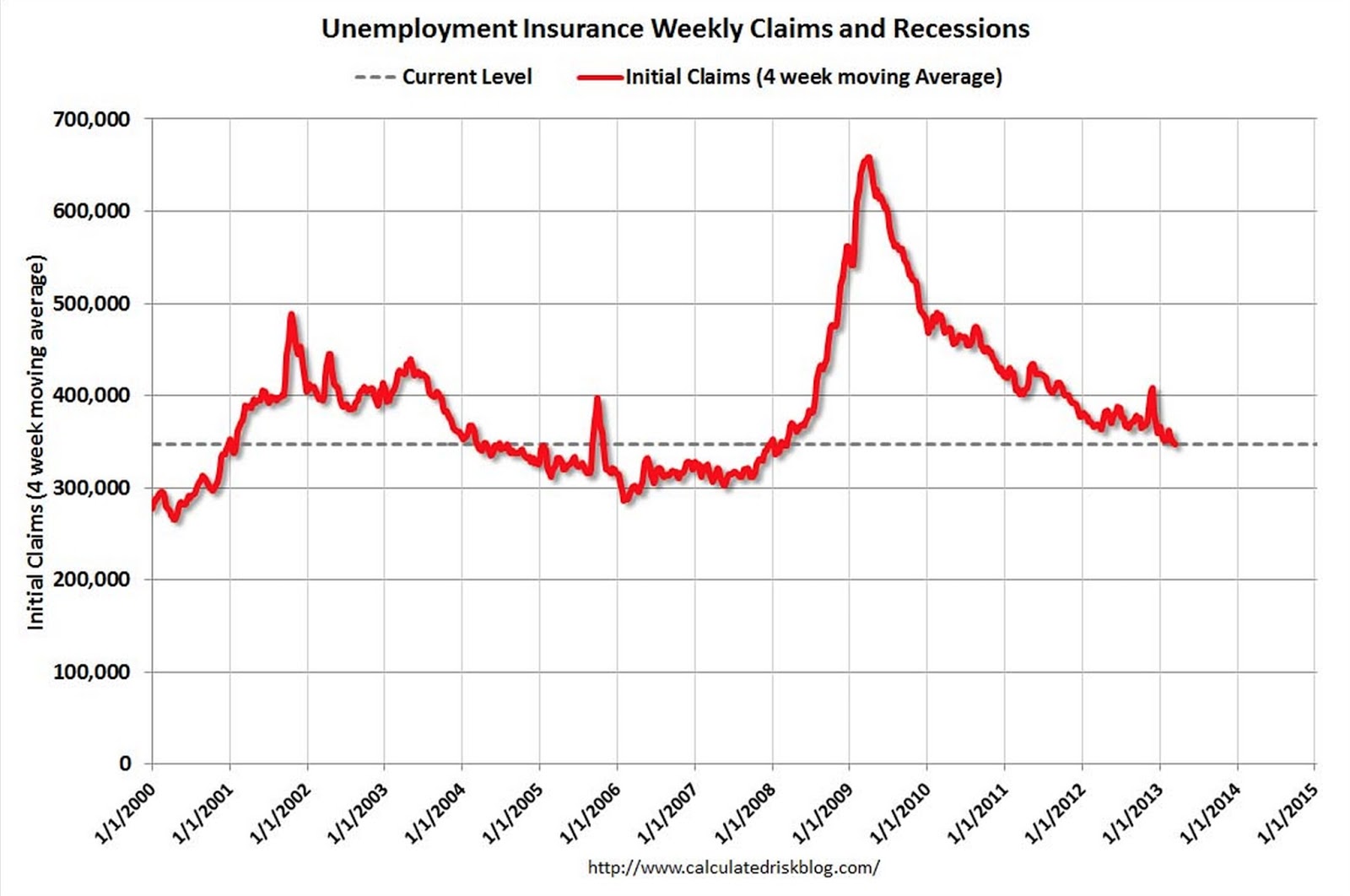
- Finally, initial unemployment claims in the US seem to be falling again, which is good news:
Labels:
links
Wednesday, March 13, 2013
Tuesday, March 12, 2013
Tuesday Links
- China is now the largest oil importer in the world, having surpassed the US.
- If I was a South Korean, I'd be feeling this way too. When your neighbor is openly talking about incinerating your cities with nuclear weapons, and they have nuclear weapons, it's pretty hard to sit there and not respond. In general, North Korea seems pretty worrying at the moment.
- That said, the commander of PACOM, Admiral Locklear, who is in charge of worrying about North Korea and China both, says he's most worried about climate change.
- On the third hand, the Director of National Intelligence has now elevated cyberattacks to the number one threat to the US.
- Krugman (relevant to yesterday's GDP graph): "Mario Draghi’s actions, by stabilizing markets and bringing down spreads, bought Europe quite a lot of time; Europe is determined to waste all of it."
- Somebody reminded me yesterday of this paper I did with some collaborators back in 2004, causing me to reread it again. It concerns how fast a computer worm could infect a large population of vulnerable computers spread all over the Internet - the answer turns out to be well under one second. I think it's my favorite of my published papers (both because I love thinking about really big bad stuff that could happen, and because the actual analysis was a lot of fun). Abstract:
Flash worms follow a precomputed spread tree using prior knowledge of all systems vulnerable to the worm’s exploit. In previous work we suggested that a flash worm could saturate one million vulnerable hosts on the Internet in under 30 seconds. We grossly over-estimated.This has still never been done in the wild, but I bet that, at some point in coming decades, someone will do this somewhere.
In this paper, we revisit the problem in the context of single packet UDP worms (inspired by Slammer and Witty). Simulating a flash version of Slammer, calibrated by current Internet latency measurements and observed worm packet delivery rates, we show that a worm could saturate 95% of one million vulnerable hosts on the Internet in 510 milliseconds. A similar worm using a TCP based service could 95% saturate in 1.3 seconds.
The speeds above are achieved with flat infection trees and packets sent at line rates. Such worms are vulnerable to recently proposed worm containment techniques. To avoid this, flash worms should slow down and use deeper, narrower trees. We explore the resilience of such spread trees when the list of vulnerable addresses is inaccurate. Finally, we explore the implications of flash worms for containment defenses: such defenses must correlate information from multiple sites in order to detect the worm, but the speed of the worm will defeat this correlation unless a certain fraction of traffic is artificially delayed in case it later proves to be a worm.
Update (1pm eastern): A Japanese research drilling vessel has apparently successfully tapped undersea methane hydrates for the first time.
Labels:
links
Monday, March 11, 2013
Friday, March 8, 2013
Thursday, March 7, 2013
Wednesday, March 6, 2013
Tuesday, March 5, 2013
Tuesday Links
- The above figure (from the EIA) shows the seasonality of electricity demand by sector (residential, commercial, and industrial) in the US. All are mainly summer peak demand. It's interesting to think about this in the context of a carbon neutral economy in which heating would presumably mainly be done via heat-pumps (creating a large winter peak in demand also), and electricity would be supplied by wind and solar (with the latter being very much a summer peak thing). Right now my guess is still that the only way to pull off a fully renewable-based economy is via global electricity trade (since storing electricity from summer to winter sounds really hopeless, whereas global electricity trade seems only somewhat quantitatively harder than the intra-continental electricity trade we do now).
- Corporate profits soar as labor income stagnates.
- The New York Times kills its Green blog (after having already dismantled its environmental desk). The optics of this, at a minimum, are appalling.
- David Brooks on the incentives for the US in dealing with Chinese commercial cyber-espionage.
- Why are the Chinese hacking into US/Canadian pipeline and electric grid companies? Very good question. I was particularly amused by this quote:
At a moment when corporate America is caught between what it sees as two different nightmares — preventing a crippling attack that brings down America’s most critical systems, and preventing Congress from mandating that the private sector spend billions of dollars protecting against that risk — the Telvent experience resonates as a study in ambiguity.
Labels:
links
Monday, March 4, 2013
Sunday, March 3, 2013
Global Warming Perspective of 1958
Interesting to understand the perspective at that time. They already knew that a few degrees warming was a really big deal.
Labels:
climate change,
climate sensitivity
Weekend Links
- The above graph is long term interest rates across multiple developed countries (Ben Bernanke via James Hamilton). My initial guess is this is due to globalization - it doesn't make a lot of sense to invest in mature developed countries when a lot of the jobs are being outsourced to the developing world, so desired investment is below desired savings, and therefore real interest rates are dropping to zero throughout the developed world. I'm far from certain, however. Clearly, deleveraging from the debt boom is part of the story too.
- Apparently drought is even affecting Hobbiton now. Nothing is sacred to climate change, it seems.
Labels:
links
Friday, March 1, 2013
European Unemployment up in Jan
The figures just came out today. So Eurozone unemployment is now almost 12% on an average basis, and still climbing.
Labels:
europe,
unemployment
Subscribe to:
Posts (Atom)