Monday, September 24, 2012


Saturday, September 22, 2012
Weekend Links

- The chart above shows that life expectancy is actually falling, and pretty rapidly at that, for white US residents without a degree. Surprising and alarming fact. It's also surprising that less-educated Hispanics are doing so much better than whites.
- Background on heat-pump hot-water heaters. Ours is being installed next week and I imagine I'll have something to say about it at some point later.
- More on the US wind industry crisis - a mixture of China and Republicans are causing dropping sales and loss of jobs in the industry (not to mention more carbon emissions).
- David Brooks on the importance of grandiose, ambitious but functional narcissists to society. I kind of agree with this. Related book: The Productive Narcissist.
- Fascinating post on the very small number of voters who are actually undecided in the election.
- Mostly off-topic (but not quite), fascinating essay by Sharon Astyk on the economics of foster-parenting.
Friday, September 21, 2012

Thursday, September 20, 2012
Thursday Links

- The arresting comparison above is of the main Chinese stock market index with the Japanese one, and comes via Sober Look.
- ConservAmerica is an organization trying to make the Republican Party greener and promote the conservative tradition of environmental protection. I don't fully agree with their positions, but it still seems worthy to be trying to bring the GOP to a more sane place on the environment than it currently is in.
- Sea ice minimum in? Staring at this graph, that looks like it could well be right, but I wouldn't rule out the possibility of a last little jog down.
- Scientist Julienne Stroeve just came back from a voyage through the sea ice and reported they could only find one floe big enough to moor to, and that one broke in half while they were moored to it.
- Siemens cutting a third of the jobs in its US wind business due to lack of new orders.
- $4/gallon? Been there, done that.
- Excellent slides from a July 2012 presentation on drought by Aiguo Dai in Beijing. Note Prof Dai says:
Larger warming over land than over ocean leads to - larger PE increases over land than over ocean - increases in water vapor transport from oceans can not match atmospheric demand over land -> drier conditions over land.This is a suggestion I made earlier - but in email I had with him at the beginning of 2012 he didn't confirm it - so I'm happy to see him do so here.
This graph was also particularly interesting - suggesting that recent improvements to latest climate models (CMIP5 vs CMIP3) haven't changed the answer much:
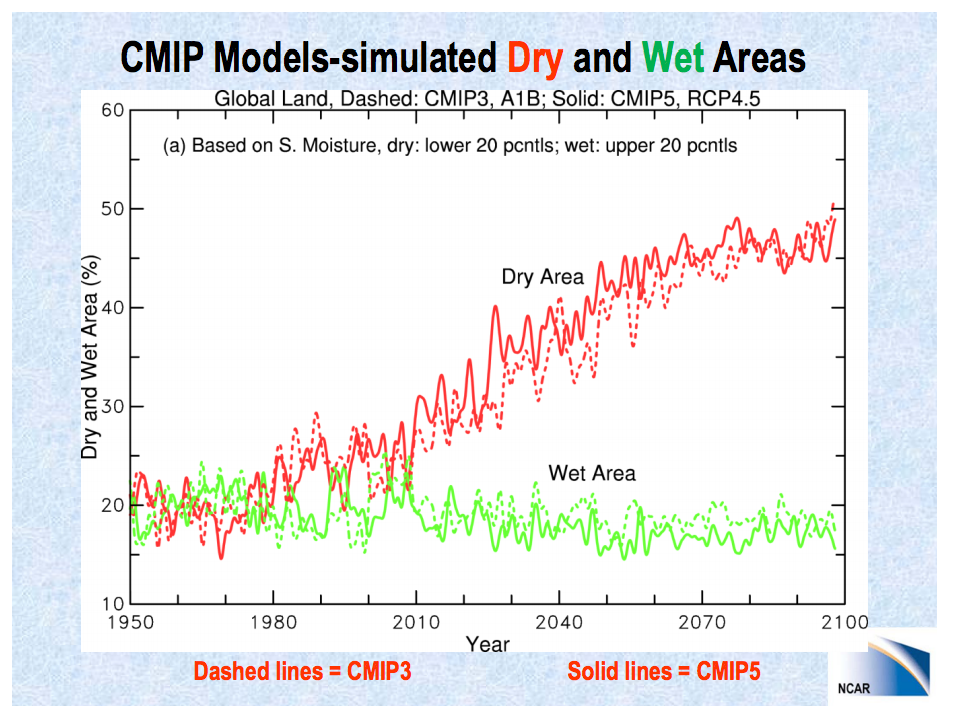
The current dry conditions in the U.S. may last and worsen during the next 20 yrs as the IPO cold phase persists and global warming continues.
Off Topic Worthy Cause: American Co-operative School in Tunis
A friend of my family is the principal at the high school in the American Co-operative School in Tunis - which was recently looted and badly damaged in an attack by Islamic radicals and delinquents. They have now launched a recovery fund to help them rebuild. I think it would be good for American society to show a peaceful determination not to back down in the face of that kind of violent intimidation and to rebuild the school. The staff are displaying a great deal of personal courage in sticking with the school and rebuilding it after what has happened. I encourage my readers to both donate and share the link with others: www.acst.net.
Wednesday, September 19, 2012

Tuesday, September 18, 2012

Tuesday Links

- The above is European industrial production, which seems to be showing some sign of stabilization.
- Arctic sea ice gone by 2015/2016? Prof Wadhams is one of the world's leading experts on sea ice. Because he has been involved in measuring ice thickness for a long time, he was one of the few experts to predict the present early collapse.
- Chinese trade data weak in August.
Monday, September 17, 2012

Sunday, September 16, 2012
Weekend Links

- Sea ice area has managed to go down even further. Still dropping, though the bottom must come soon.
- Poor economics of south facing windows in net-zero homes.
- What may be going on over Greenland.
- Extreme weather, extreme prices.
- Hard commodity prices may collapse. Oil - not so much, I would think.
Thursday, September 13, 2012
Thursday Links
- David Brooks on why US men are failing.
- Netanyahu publicly chastising Obama for being soft on Iran.
- Israeli leaders fighting amongst themselves, too. All this must be giving comfort in Tehran.
- But, notwithstanding, things are not going that great there either.
- Jim Hamilton reminds us that you never know where to expect trouble next in the oil markets - Iran is not the only game in town.
- Good summary of the sea ice situation - what happened and what it might mean.
Wednesday, September 12, 2012

Tuesday, September 11, 2012
Tuesday Links

- The chart above is improving fuel economy of new vehicles in the US.
- The employment population ratio no longer responding to job opportunities?
- Thoughtful Bill Keller op-ed on a nuclear Iran.
- Introverts unite!
- The next Chinese leader has disappeared?
- This next chart is from a paper by economist Robert Gordon arguing that we may be slowing toward a steady state economy and that the growth rates of the industrial revolution were a one time thing. This comes as no surprise to those of us who think energy is foundational to the economy. It doesn't seem to have occurred to Professor Gordon that smoothly slowing to zero growth is not the worst outcome here...

Monday, September 10, 2012

Sunday, September 9, 2012
Weekend Links

- The above is from a post from Chris Reynolds arguing that there has been a persistent change in the weather since 2007 (the year of the beginning of the big collapse in the sea ice) in which the air pressure over Greenland is higher and the air pressure over the UK is lower. Read the precursor post here too. The posts are quite persuasive - and if he's right, this is huge.
- Latest stats on US corn usage for ethanol (h/t Big Gav).
- Documenting the Weatherization Assistance Program.
- Energy balance of the Arctic (h/t Woody).
- No climate benefit from fracking?
- Hurricanes intensify faster than they used to.
- Saudi Arabia may be oil importer by 2030. If you stop and think about who would export to them, it's hard to see how this could go well...
- Alaskan methane?
Friday, September 7, 2012
Politics and this Blog
It probably hasn't escaped the attention of readers that my politics are a little left of center - with the typical meanings of "left" and "center" in current US politics. This "leftiness" is greater on some issues (environment, social issues, civil rights), and much less so on others (education, wealth redistribution). I have at various points been registered either Democrat or Independent.
So far, on the blog I have been pretty careful to avoid outright partisanship. Partly this is a matter of personality: it comes more naturally to me to play the disinterested analyst role than the role of an activist and partisan. At the same time, it's impossible not to notice that for the issues I most care about - climate, energy, environment, and future of society - the Democratic party (while far from perfect) is currently a lot better than the Republican party. This is so overwhelmingly true at present that I don't feel a need to make an argument in detail: it's become so extreme that Republican politicians almost uniformly have to be delusional on climate change (or at least pretend to be). Thus I've struggled with whether I'm being too coy in not taking an explicitly partisan position: actively urging readers to political action, or endorsing Democratic candidates, for example.
For now, at least, I have decided not to do that. My reasoning is as follows: I think in the deepest part of its soul, what the Republican party is about is protecting the interests of the most economically successful members of society: hence the focus on lightening their taxation burden, reducing regulations that might impede their enterprises, promoting their right to pass their wealth to their children, etc. I don't lack all sympathy for this agenda: I think the most economically successful people are particularly important to society at large and it is possible for a society to go too far in the direction of impeding them (though that is not my diagnosis of the main problem for the US in 2012).
And I note that climate change, drought, running low on energy or food (with the resulting instability, riots, etc) are not in the long-term interests of the wealthy either. Wealth is a social construct that is entirely dependent on a reasonable degree of political and economic stability. During times of disorder, the wealthy are at risk of losing everything they have gained, ranging from those families that lost the family fortune in the Great Depression - or the 90% marginal tax rates and high estate taxes that followed - to the extremes of the French Revolution when much of the elite were slaughtered in a genocidal frenzy. I'm not aware of a single Roman Villa that evolved smoothly into a medieval manor.
So, if we are to have any hope of some kind of fairly orderly transition into a carbon-neutral sustainable society, at some point our millionaires and billionaires have to come to their senses and recognize that destabilizing key planetary systems on which we all depend is not going to do them and their children the slightest bit of good. In fact, we need talented green entrepreneurs and investors to be brilliant and wildly successful perhaps more than we need any other single thing.
And so I want this blog to be a hospitable environment for successful individuals who can be persuaded that these problems are important and should be worked on. And, at least for the time being, I think that is best served by continuing to avoid explicit partisanship.
So far, on the blog I have been pretty careful to avoid outright partisanship. Partly this is a matter of personality: it comes more naturally to me to play the disinterested analyst role than the role of an activist and partisan. At the same time, it's impossible not to notice that for the issues I most care about - climate, energy, environment, and future of society - the Democratic party (while far from perfect) is currently a lot better than the Republican party. This is so overwhelmingly true at present that I don't feel a need to make an argument in detail: it's become so extreme that Republican politicians almost uniformly have to be delusional on climate change (or at least pretend to be). Thus I've struggled with whether I'm being too coy in not taking an explicitly partisan position: actively urging readers to political action, or endorsing Democratic candidates, for example.
For now, at least, I have decided not to do that. My reasoning is as follows: I think in the deepest part of its soul, what the Republican party is about is protecting the interests of the most economically successful members of society: hence the focus on lightening their taxation burden, reducing regulations that might impede their enterprises, promoting their right to pass their wealth to their children, etc. I don't lack all sympathy for this agenda: I think the most economically successful people are particularly important to society at large and it is possible for a society to go too far in the direction of impeding them (though that is not my diagnosis of the main problem for the US in 2012).
And I note that climate change, drought, running low on energy or food (with the resulting instability, riots, etc) are not in the long-term interests of the wealthy either. Wealth is a social construct that is entirely dependent on a reasonable degree of political and economic stability. During times of disorder, the wealthy are at risk of losing everything they have gained, ranging from those families that lost the family fortune in the Great Depression - or the 90% marginal tax rates and high estate taxes that followed - to the extremes of the French Revolution when much of the elite were slaughtered in a genocidal frenzy. I'm not aware of a single Roman Villa that evolved smoothly into a medieval manor.
So, if we are to have any hope of some kind of fairly orderly transition into a carbon-neutral sustainable society, at some point our millionaires and billionaires have to come to their senses and recognize that destabilizing key planetary systems on which we all depend is not going to do them and their children the slightest bit of good. In fact, we need talented green entrepreneurs and investors to be brilliant and wildly successful perhaps more than we need any other single thing.
And so I want this blog to be a hospitable environment for successful individuals who can be persuaded that these problems are important and should be worked on. And, at least for the time being, I think that is best served by continuing to avoid explicit partisanship.
Thursday, September 6, 2012
Thursday Links

- The latest sea ice area from Cryosphere Today. If you didn't believe in abrupt climate change before: think again. Incredible that we are living through this.
- Weathergirl goes rogue on climate (humor - but it sure does feel like this sometimes. h/t Ugo Bardi).
- Fleeing Spain for better economic climes.
- What hope for a country where the accountants are one of the least honest professions? Not much, I'd guess.
- German voters have written them off, anyway.
- California set to approve driverless cars (h/t Kevin Drum). Note the rare bipartisan agreement - new technology always tastes great on the first bite.
- Dry-ship R-22 units. This sounds appalling. If true, the administration should not be tolerating this, and if you're buying a heat-pump or an A/C unit, ask if it uses R-22.
- Major scientific breakthrough in genetics - sounds like Nobel prizes in the making...
- Late breaking addition: ECB can do unlimited amounts of bond buying to keep short term rates of Spain/Italy within reason.
Wednesday, September 5, 2012
European Retail Trade

The latest data show that consumers in Europe as a whole seemed to have reached the steady state economy. However, inside the Eurozone, retail spending continues to slide slowly. Combined with the unemployment data, we can see that Europe continues to stagnate - it has not solved its fundamental problems, but nor has it slid into acute crisis.
Tuesday, September 4, 2012


Sunday, September 2, 2012
Weekend Links
- Israel needs to put up or shut up about attacking Iran, says the NYT.
- More big cyber attacks on oil and gas concerns. My day job and my morning moonlighting are starting to overlap and I don't like it...
- Why you should care about disappearing sea ice.
- Wettest summer since 1912 in the UK (h/t Michael R. I was there for much of July and I can attest that the weather sucked).
- The 2010 collapse in sea ice thickness.
Friday, August 31, 2012

Thursday, August 30, 2012
Arctic Sea Ice Volume

In response to this morning's links post, commenter Stephen B argued that:
I don't think one needs to be any kind of climate scientist to understand what is about to happen to the remaining ice. In the next 3 years, at some point, the remaining ice is going to be so thin and so relatively fresh, that late one summer in say, August of 2014 to 17, scientists are going to look at their satellite data, and see essentially zero ice. Anybody that's watched a large lake or bay melt understands how they go. First, the edges fray. Some chunks break off, but the main slab grows thinner, wetter, darker, and more "rotten." Then one day in the spring the whole thing, say like 75% of the surface, just breaks up to slush in a matter of hours and it's gone.I grabbed the ice volume data from Piomas, computed the minimum volume each year, and plotted the result above. Note that 2012 is not final as there's still several weeks of the normal melt season left.
The purple line is a linear trend - explaining 82% of the variance. It clearly has systematic problems - the ice collapse is accelerating, not just proceeding linearly.
A quadratic (red) is a visibly much better fit and explains 92% of the variance. The quadratic hits zero in 2017.
It doesn't seem crazy to think that the Arctic will be ice free in September sometime this decade.
Strange that explorers competed for years to travel by sled to a place that will no longer exist. Maybe I'm naive, but it seems this will change the debate about climate change - the complete absence of a polar ice cap seems much easier for an ordinary person to understand, versus complex arguments about data-analysis on global temperature statistics, requiring that you trust scientists and their computer models. Arguing that climate change isn't happening will become akin to arguing that the earth is flat.

Thursday Links

- "If you believe we can do this to the planet without consequences, you’re a fool."
- Average fuel economy for new US cars of 54mpg by 2025 - that will help.
- Peak Nuclear Power? Gail might well be right about this.
- Future of Chinese steel demand.
- Largest rainstorm of the year getting larger.
- And finally, Who wears the Pants in This Economy? puts some interesting human stories on this trend:

Wednesday, August 29, 2012
PIIGS Unemployment Chart

Every picture tells a story, they say. This one tells a story of unrelenting misery and hardship, dreams crushed and hopes fading, year after year after year. Still no sign of any relief for the real economy in these countries.
The data run through June 2012, except for the Greeks who are only up to May.
Tuesday, August 28, 2012
Tuesday Links
- More on the Saudi Aramco cyberattack.
- Soy prices following corn prices sharply upward.
- Wheat too.
- Potential impact of Hurricane Isaac on GoM oil production.
- Future demand for lithium.
Monday, August 27, 2012

Sunday, August 26, 2012
Weekend Links
- Romney plan for energy US independence (hoping to join a fine Presidential tradition, I guess).
- Iranian regime speeding up nuclear fuel refining. This was a predictable consequence of trying to negotiate with them. It's perfectly clear that Iran is betting the farm on developing nuclear weapons. The choices are major military action real soon, or acceptance and deterrence/containment.
- Also more on Fordow - the deep underground Iranian enrichment site and what the bombing option looks like.
- Who benefits from a weak euro?
- Global groundwater depletion map.
- Onion: Lower Class Grateful not to be Middle. (h/t Big Gav)
- 46% of Americans say they are creationists. 58% amongst Republicans, and 2/3 amongst weekly church goers.
Friday, August 24, 2012

Thursday, August 23, 2012
Interesting Thursday Links

- The chart above is new electricity generation by fuel source over time in the US.
- The challenges ahead in battery research. (I would be somewhat more optimistic - making some allowance that researchers emphasize problems as motivation for their research - and also that commercialization is not about solving the whole problem at once but rather finding a series of increasingly large niches that eventually scale to the whole market - but much of the post is very informative).
- Climate is Really Changing - nothing new but a nice concise summary from Tamino.
- Progression of obesity in OECD countries.
- What the US needs to do to balance the budget.
- Chinese PMIs continue to look weak. This is consistent with the weak global trade data and oil supply that is not expanding.
- Build your own stonehenge.
- Balkans in drought too.
Wednesday, August 22, 2012

Tuesday, August 21, 2012
Interesting Links: Tuesday Edition

- The above is the global temperature anomaly map for July 2012 - the hottest month in recorded history for the lower 48 states of the US - from NASA GISS (h/t Desdemona Despair).
- New CAFE rules should be finalized this month.
- The price of hay in the midwest has doubled due to the drought. If there was a cellulosic ethanol industry there, it'd be hurting.
- Making soft robots that can move and camouflage themselves. Words fail.
- Record low sea ice area in the Arctic already - and still several weeks to go to the minimum.
- United States on track for worst fire year since records began.
- It's also challenging to keep the Mississipi open for boat traffic.
- Economists discover in 2012 that loan-to-income rules would have been a good idea during the housing bubble. We're glad you finally figured that one out...
- Inflation is more cyclical than has been measured, due to store switching (going to Walmart during recessions).
Monday, August 20, 2012

Sunday, August 19, 2012
Interesting Links
- Whatever you think about Julian Assange, he is at least leading a very interesting and unique life.
- Iraq may be helping Iran to avoid western sanctions and export oil.
- Here in New York State, governor Cuomo signed into law new tax incentives for solar power.
- Robots continue to get better at displacing people.
- Bridging rivers with living bridges made from tree roots. H/t Big Gav and Long Now.
Saturday, August 18, 2012
Bleg: Thin Film Solar Modules on Aging Barn Roof
A quick question: I'm starting to research installing solar at our place near Ithaca (always my intention from when we bought it, but other projects had to happen first).
It seems to me appealing to put the solar power on the barn rather than the house:
Secondly - the sheet metal on the barn roof is a few decades old. While the roof isn't in imminent danger of failing, about 50% of the roof area now looks rusty and about 50% still has the galvanized surface. I've already had a contractor offer to cover the roof with an aluminized asphalt product to extend the life of the metal. Clearly, it's not desirable to attach solar modules to metal with a noticeably shorter life than the modules.
One idea that occurs to me is to use an aluminized asphalt product to adhere the modules to the metal, and cover the whole roof at the same time in the interests of preserving it.
Does anyone have any experience with a similar situation?
It seems to me appealing to put the solar power on the barn rather than the house:
- It has a much larger area (ie more power)
- The cosmetic impact from the road will be lower
Secondly - the sheet metal on the barn roof is a few decades old. While the roof isn't in imminent danger of failing, about 50% of the roof area now looks rusty and about 50% still has the galvanized surface. I've already had a contractor offer to cover the roof with an aluminized asphalt product to extend the life of the metal. Clearly, it's not desirable to attach solar modules to metal with a noticeably shorter life than the modules.
One idea that occurs to me is to use an aluminized asphalt product to adhere the modules to the metal, and cover the whole roof at the same time in the interests of preserving it.
Does anyone have any experience with a similar situation?
Friday, August 17, 2012
Saudi Aramco Network Hit With Cyber-Attack
Apparently they shut down the network:
Saudi Aramco, Saudi Arabia’s national oil company and the largest in the world, has confirmed that is has been hit by a cyber attack that resulted in malware infecting user workstations, but did not affect other parts of its network.Word is that this was due to the Disttrack malware that was only discovered yesterday:
“On Wednesday, Aug. 15, 2012, an official at Saudi Aramco confirmed that the company has isolated all its electronic systems from outside access as an early precautionary measure that was taken following a sudden disruption that affected some of the sectors of its electronic network,” the company wrote in a statement.
“The disruption was suspected to be the result of a virus that had infected personal workstations without affecting the primary components of the network.”
The company did not comment on the vector of attack or who may behind it, but insists its core operations have not been impacted as a result of the security breach.
Malware being used in a new series of targeted attacks has bucked the trend, choosing to destroy the computers it infects rather than just stealing sensitive information, security researchers said.Given the unusual destructiveness of the malware, one can't help suspecting an Iranian or Syrian revenge operation - but no evidence one way or another at present. Anyway, pretty interesting to have the world's largest oil company victim of a major cyberterrorism incident.
Called "Disttrack", the malware corrupts files, overwrites the infected machine's master boot record, and destroys the data so that it can't be recovered, according to reports from Symantec Security Response, Kaspersky Lab's Global Research and Analysis Team, and McAfee on Thursday. Disttrack has been observed in the Shamoon attacks, which has already affected at least one organization in the energy sector, Symantec said, but the company declined to provide any other details about the affected organization(s).

A Few Interesting Links
- Are we getting better at predicting when AI will arrive?
- Heating cold climate houses with two minisplits (new, super-insulated ones, anyway).
- New Hansen paper on increasing extremes in temperature.
- Interesting Kickstarter project that some might find worthwhile (global environmnental simulation by an early computer game pioneer).
- Water conservation ideas for responding to the current US drought.
- Israeli sabre rattling over Iran is getting louder again.
- Brent-WTI spread growing again.
- Modest progress on US carbon emissions in 2011.
Thursday, August 16, 2012

Wednesday, August 15, 2012

Friday, August 10, 2012

Wednesday, August 8, 2012

Monday, August 6, 2012
Total Available Renewable Resource
Several commenters questioned Friday's post on the grounds that the total amount of solar and wind power potentially available is insufficient to power modern civilization
This is incorrect.
Total available wind power available on land and near shore has been estimated at 72TW. This is close to five times current total primary energy consumption, and still more than twice as large as energy consumption in 2040 (extrapolating at the 2.7% growth rate of the last decade).
Of course, not all technically and economically feasible wind sites are politically feasible. Thus it's important that total incoming solar radiation is also very large. Top of the atmosphere incoming solar radiation is 174000TW. If we just look at the world's desert areas, they represent about a third of the global land area, itself about 30% of the total surface. Allowing 30% losses in the atmosphere over deserts, and throwing out something for Antarctica (a desert, but not a very useful one for solar power), we end up with something in the ballpark of 7000TW of available solar energy from deserts alone. This is hundreds of times larger than current civilizational energy consumption.
Therefore, constraints on our ability to utilize renewables are political and economic, not ultimate physical ones; there is plenty of renewable energy out there.
This is incorrect.
Total available wind power available on land and near shore has been estimated at 72TW. This is close to five times current total primary energy consumption, and still more than twice as large as energy consumption in 2040 (extrapolating at the 2.7% growth rate of the last decade).
Of course, not all technically and economically feasible wind sites are politically feasible. Thus it's important that total incoming solar radiation is also very large. Top of the atmosphere incoming solar radiation is 174000TW. If we just look at the world's desert areas, they represent about a third of the global land area, itself about 30% of the total surface. Allowing 30% losses in the atmosphere over deserts, and throwing out something for Antarctica (a desert, but not a very useful one for solar power), we end up with something in the ballpark of 7000TW of available solar energy from deserts alone. This is hundreds of times larger than current civilizational energy consumption.
Therefore, constraints on our ability to utilize renewables are political and economic, not ultimate physical ones; there is plenty of renewable energy out there.
Friday, August 3, 2012

Wednesday, August 1, 2012
Eurozone Unemployment

The numbers came out yesterday and are as above - a slight stall, but no real evidence of a reversal. Also, every one of the PIIGS countries saw their unemployment rate get worse in the latest month.
So there is still no sign of stabilization in the real economy in Europe.
Monday, July 30, 2012

Friday, July 27, 2012

Wednesday, July 25, 2012

Monday, July 23, 2012

Friday, July 20, 2012

Thursday, July 19, 2012
Administrivia: MWF Schedule
Just a short note on blog schedule. Historically, I aimed on this blog to do a post once each morning on weekday mornings. This was never perfectly true: I always missed the odd morning when something didn't work out, and have occasionally added extra lunchtime or weekend posts as time and interest allowed.
However, in recent months I've had a lot of work-related travel and I've been failing more consistently to do more than a few posts each week. I think it would be better to acknowledge this explicitly and provide readers with a bit more predictability by switching to a target schedule of posting Monday, Wednesday, and Friday mornings. Again, this won't be perfectly true, but I'll aim to make it true 90% of the time. Posts will continue to be primarily quantitative/empirical exploration of issues in the area of energy/environment/economy with a focus on things that I think are important but not well-enough covered elsewhere.
However, in recent months I've had a lot of work-related travel and I've been failing more consistently to do more than a few posts each week. I think it would be better to acknowledge this explicitly and provide readers with a bit more predictability by switching to a target schedule of posting Monday, Wednesday, and Friday mornings. Again, this won't be perfectly true, but I'll aim to make it true 90% of the time. Posts will continue to be primarily quantitative/empirical exploration of issues in the area of energy/environment/economy with a focus on things that I think are important but not well-enough covered elsewhere.
Bleg on Minisplit Ductless Airsource Heat Pumps
Sources have told me that in the last few years it has become possible to heat buildings in cold climates (eg the US northeast) with the latest generation of ductless minisplit air-source heat pumps. I am seeking detailed technical information on the performance of these kinds of systems that would allow me to evaluate the low temperature limits, thermodynamic efficiency, and cost-effectiveness of doing this in a retrofit context. I haven't easily come up with sufficiently detailed information in Googling around - can any readers point me in the right direction?
Wednesday, July 18, 2012
Tight Oil could not Render OPEC Irrelevant
Steve Levine has a blog post discussing the idea that the "unfolding new age of fossil fuel abundance" will have profound effects on various things, including OPEC:
With prices dropping and competing supplies flowing from numerous new producers, OPEC will lose much relative influence, and may simply cease to be a pivotal economic player. "OPEC will descend into chaos as an organization," said John Hofmeister, former president of Shell USA. "They don't know now how much they are hated by the entire world. But they will find out as things unfold."The key factor behind this kind of thinking is the rapid rise of production of oil from tight rocks like the Bakken in North Dakota and the Eagle Ford in Texas. I haven't taken a strong position on what the limits of production are from these sources - it just isn't clear to me yet from the data that I have available. But we could certainly place some limits on how much geopolitical impact this could have on OPEC.
Monday, July 16, 2012

Friday, July 13, 2012

Wednesday, July 11, 2012

Friday, July 6, 2012

Thursday, July 5, 2012

Wednesday, July 4, 2012

Tuesday, July 3, 2012

Subscribe to:
Posts (Atom)