Friday, July 15, 2011


Thursday, July 14, 2011
Taking "Singularity" Apart
The term "singularity" as applied to the medium-term future of technology/humanity bundles together a variety of predictions for purposes that suit advocates of continued technological development, but don't necessarily have to occur together. In this post, I want to briefly point out the different pieces, and comment on the strength of the connections. For readers wanting some more background on the concept, the Wiki article is a good place to start.
Wednesday, July 13, 2011

Tuesday, July 12, 2011

Monday, July 11, 2011
Hmmm
New research effort:
Last month President Obama traveled to Carnegie Mellon University in Pittsburgh to unveil a $500 million effort to create advanced robotic technologies needed to help bring manufacturing back to the United States. But lower-cost computer-controlled mechanical arms and hands are only the first step.So we're hoping to replace Chinese peasants with robots in factories here. This is going to help unemployed Americans how?


Sunday, July 10, 2011

Saturday, July 9, 2011

Tuesday, July 5, 2011

Friday, July 1, 2011

Thursday, June 30, 2011

Wednesday, June 29, 2011

Tuesday, June 28, 2011

Monday, June 27, 2011
Do Energy/Environment Blogs get read in Government?
Apparently so. From one of the internal EIA email exchanges released by the NYT in association with the Urbina shale gas articles (p33 of here):


Question about the New York Times
There's another couple of pieces by Ian Urbina in the New York Times. This is the guy last seen noting that there's a lot of radioactivity in some of the wastewater from shale gas drilling/fracking. The new pieces report on a lot of internal skepticism at energy companies and regulators, respectively, about the economics of shale gas:
But the gas may not be as easy and cheap to extract from shale formations deep underground as the companies are saying, according to hundreds of industry e-mails and internal documents and an analysis of data from thousands of wells.
In the e-mails, energy executives, industry lawyers, state geologists and market analysts voice skepticism about lofty forecasts and question whether companies are intentionally, and even illegally, overstating the productivity of their wells and the size of their reserves. Many of these e-mails also suggest a view that is in stark contrast to more bullish public comments made by the industry, in much the same way that insiders have raised doubts about previous financial bubbles.
“Money is pouring in” from investors even though shale gas is “inherently unprofitable,” an analyst from PNC Wealth Management, an investment company, wrote to a contractor in a February e-mail. “Reminds you of dot-coms.”
“The word in the world of independents is that the shale plays are just giant Ponzi schemes and the economics just do not work,” an analyst from IHS Drilling Data, an energy research company, wrote in an e-mail on Aug. 28, 2009.
Friday, June 24, 2011

Thursday, June 23, 2011

Wednesday, June 22, 2011

Tuesday, June 21, 2011

Monday, June 20, 2011

Friday, June 17, 2011

Thursday, June 16, 2011

Wednesday, June 15, 2011

Tuesday, June 14, 2011

Monday, June 13, 2011

Friday, June 10, 2011
Saudi Arabia to Produce 10mbd in July?
At the end of April, I noted this WSJ quote:
You ought to be able to rely on that, right? Mr al-Naimi must know how much oil his fully nationalized oil industry produces. And the Wall St Journal surely wouldn't make an error in reporting his words. And even if you didn't believe the Murdoch-owned conservative WSJ, you have the left-leaning SF Chronicle reporting the same thing. And clearly, if they are giving three decimal places, it's not some off-the-cuff remark. He must have spoken with some precision from notes, or given a printed handout or the like, to mention both months with four significant figures each. So it must be true, right?
Saudi Oil Minister Ali Al-Naimi said Sunday that oil production from the kingdom was 8.292 million barrels per day in March, down about 800,000 barrels a day from 9.125 million barrels per day in February. Most estimates, including the monthly report of OPEC—which relies on external databases—had seen a rising or stable production at about nine million barrels a day in March.Ok. So here we have the Wall St Journal - premier business newspaper in the world - quoting the Oil Minister of Saudi Arabia, as to the level of Saudi oil production. With three decimal places, four significant figures, no less.
You ought to be able to rely on that, right? Mr al-Naimi must know how much oil his fully nationalized oil industry produces. And the Wall St Journal surely wouldn't make an error in reporting his words. And even if you didn't believe the Murdoch-owned conservative WSJ, you have the left-leaning SF Chronicle reporting the same thing. And clearly, if they are giving three decimal places, it's not some off-the-cuff remark. He must have spoken with some precision from notes, or given a printed handout or the like, to mention both months with four significant figures each. So it must be true, right?
OPEC MOMR Screws up Supply Graph
The OPEC MOMR is out today. Usually I comment on the latest global oil supply numbers. In this case, there seems to be some error and I can't work out what is going on. They say:
 but the graph looks like this:

Note that a) it ends in April, not May, and b) the green line is above 87, in contrast to the text saying that May was 86.77, and therefore April must have been 86.63mb/d.
Guess we got a little rushed there at the end?
Anyway, most likely supply was fairly flat in May. The IEA will have their numbers next Thursday, so hopefully that will clarify matters.

Thursday, June 9, 2011

Wednesday, June 8, 2011

Tuesday, June 7, 2011
Chinese Expressways vs US Interstates

The above graph compares the size of the US Interstate highway system (according to FHWA Table HM 220), with the Chinese Expressway system (according to the Chinese National Bureau of Statistics Table 16-4). Both series currently run through 2009. The notional extrapolation shown as the thin pink line suggests that the Chinese system will exceed the length of the US system sometime this year. We won't know for sure until 2013.
Of all the different ways that China is overtaking the US, this seems like it might be a particularly psychologically significant one to Americans.
Monday, June 6, 2011

Friday, June 3, 2011

Thursday, June 2, 2011

Wednesday, June 1, 2011

Saturday, May 28, 2011

Friday, May 27, 2011

Thursday, May 26, 2011

Monday, May 23, 2011

Friday, May 20, 2011

Wednesday, May 18, 2011

Tuesday, May 17, 2011

Monday, May 16, 2011

Saturday, May 14, 2011
Interesting Contrast
Krugman this morning
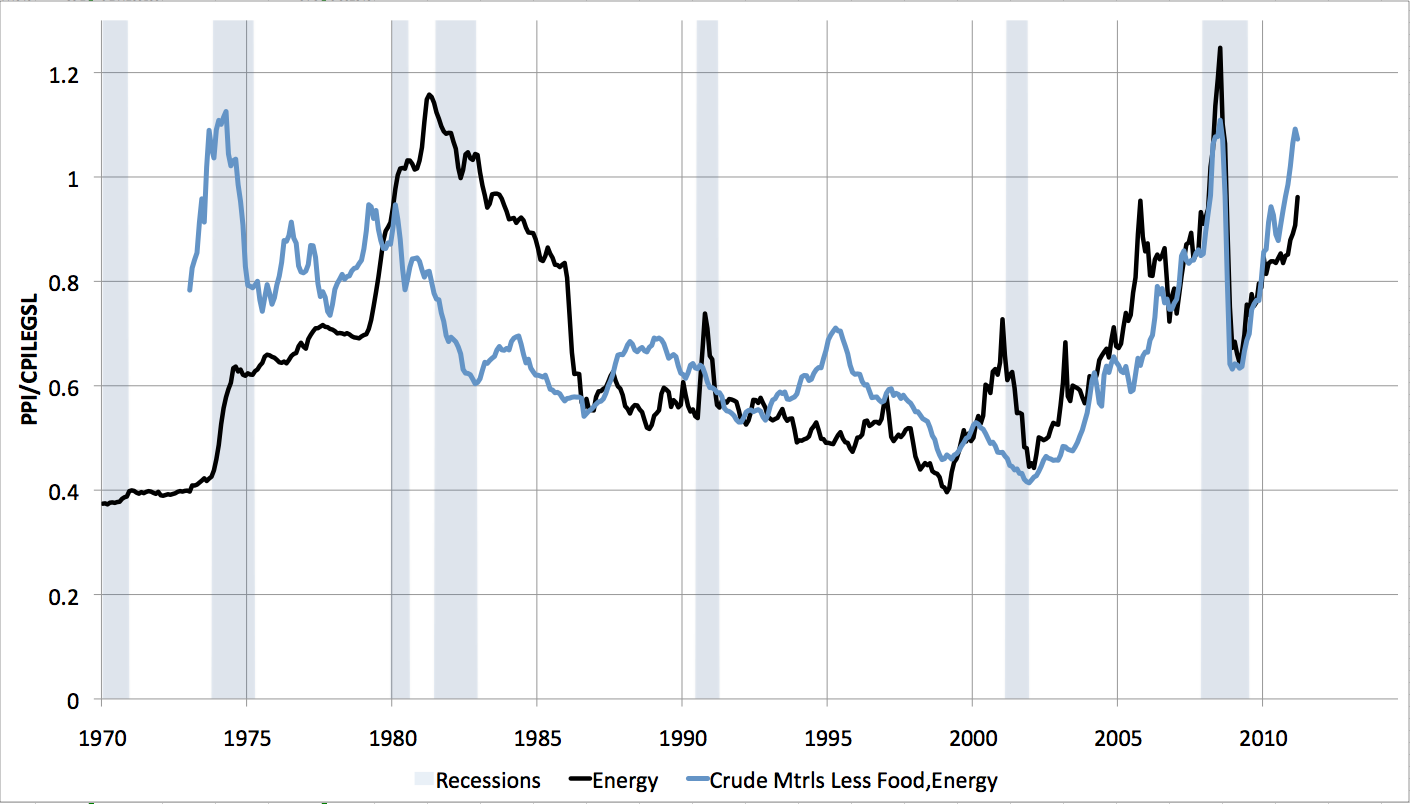
Oh, and about commodity prices: rises on the order of what we’ve seen lately aren’t at all unusual, even during periods now considered to have been characterized by low and stable inflation. Here’s the IMF commodity price index...Meanwhile, here's a UN press release about this report from a couple of days back:
Just not something to get frantic about.
Global consumption of natural resources could almost triple to 140 billion tons a year by 2050 unless nations take drastic steps, the United Nations warned Thursday.Count me with the UNEP.
A UN environment panel said the world cannot sustain the tearaway rate of use of minerals, ores and fossil and plant fuels. It called on governments to "decouple" economic growth from natural resource consumption.
With the world population expected to hit 9.3 billion by 2050 and developing nations becoming more prosperous, the report warned "the prospect of much higher resource consumption levels is far beyond what is likely sustainable."
A UN Environment Programme (UNEP) panel said the world is already running out of cheap and quality sources of some essential materials such as oil, copper and gold, which in turn need rising volumes of fuel and water to produce.
It said governments must find ways to do more with less, at a faster rate than economic growth -- the notion of "decoupling".
"We must realize that prosperity and well-being do not depend on consuming ever-greater quantities of resources," said the report.
"Decoupling is not about stopping growth. It's about doing more with less. Global resource consumption is exploding. It's not a trend that is in any way sustainable."
Friday, May 13, 2011
Note On Interruption
Google Blogger had a massive outage since sometime yesterday. Yesterday's post has been removed by them, and will hopefully be restored soon. Some recent comments have also gone missing. Hopefully normal blogging can resume soon...
Thursday, May 12, 2011

Wednesday, May 11, 2011

Tuesday, May 10, 2011

Monday, May 9, 2011

Rumors of Iraqi Target Cutback
The Australian has a news article claiming, based on anonymous sources, that Iraq will soon renegotiate the 12mbd worth of contracts that were issued in two rounds of bidding in 2009. The goal, according to the article:
Friday, May 6, 2011
Aaah
Der Spiegel:
Greece's economic problems are massive, with protests against the government being held almost daily. Now Prime Minister George Papandreou apparently feels he has no other option: SPIEGEL ONLINE has obtained information from German government sources knowledgeable of the situation in Athens indicating that Papandreou's government is considering abandoning the euro and reintroducing its own currency.
Alarmed by Athens' intentions, the European Commission has called a crisis meeting in Luxembourg on Friday night. The meeting is taking place at Château de Senningen, a site used by the Luxembourg government for official meetings. In addition to Greece's possible exit from the currency union, a speedy restructuring of the country's debt also features on the agenda. One year after the Greek crisis broke out, the development represents a potentially existential turning point for the European monetary union -- regardless which variant is ultimately decided upon for dealing with Greece's massive troubles.


Thursday, May 5, 2011

Subscribe to:
Posts (Atom)